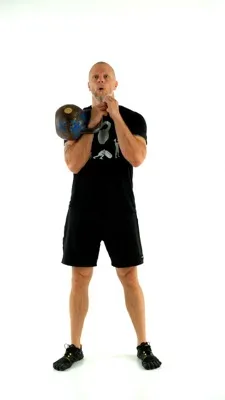
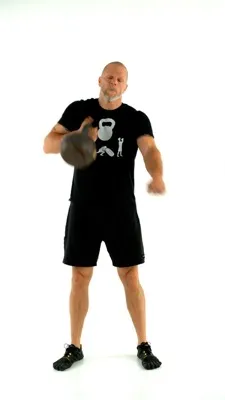
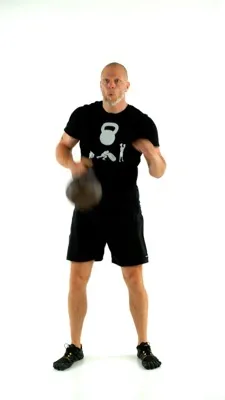
Most certifications teach you one school. We teach you the kettlebell.
Hardstyle covers swing, press, squat, snatch, and TGU. Sportstyle covers clean and jerk, snatch, and half snatch. Both are excellent — and both are a fraction of what kettlebell training actually offers. IKU covers complexes, advanced combos, flows, juggling, hypertrophy training, AMRAP and for-time formats, hybrid mobility and intensity cycles, and training methods that exist in no single school. There is more between Hardstyle and Sportstyle than within them combined. We teach all of it because limiting yourself to one style means missing most of what the kettlebell has to offer.
Biomechanics first
We teach why the hip extends at that moment, what the foot does against the ground, which muscles fire in which order. When you understand the biomechanics, you do not just perform a movement — you own it.
Continuing education
Selected courses are offered through NASM Approved Provider PRO-014438. Complete a qualifying course to earn NASM Continuing Education Units that count toward your existing fitness credentials.
Real assessment
Every certification assessment is reviewed personally. Not automated. Not a checkbox. A real human evaluates whether you can actually perform and teach the material. That is why the pass rate is 30%.
The course and certification are separate
This is the most important thing to understand about IKU. You do not have to certify to learn. Every course stands on its own — you can complete the full material and pass the knowledge exams without ever taking a physical assessment. Selected courses also offer NASM CEUs. The certification is a separate step for people who want to prove they can perform and teach the exercises professionally.
Learn for yourself
- L1 — Material ($49.95) — Access the course material. See if the teaching style and depth are right for you.
- L2 — Course ($99.95 / $129.95 CEU) — Complete the full course and pass the knowledge exams. CEU option available on selected courses. No physical assessment required.
Perfect for home trainers, experienced lifters who want deeper knowledge, and fitness professionals who need CEUs.
Prove your competence
- L3 — Trainer ($349 / $399 CEU) — Physical assessment. Demonstrate you can perform the exercises correctly.
- L4 — Teacher ($499) — Teach someone the material and film it. Prove you can transfer knowledge.
- L5 — Athlete ($699) — Rigorous physical tests under time and weight standards.
- L6 — Coach ($1,099) — Comprehensive mastery. Advanced exams plus all assessments combined.
Each level includes everything below it. Buy L3 and you get all L1 and L2 content automatically. Upgrade later and pay only the difference.
Why did we build it this way?
Traditional certifications are all-or-nothing. Pay $500 to $2,000 upfront, do the course, take the test, pass or fail. If you are not sure whether this is right for you, that is a lot of money to risk. And if you just want the knowledge — not the credential — you are paying for an assessment you do not need.
We separated the course from the certification so that the entry point is $49.95 instead of $349. You can review the material, experience the teaching style, and decide whether this is for you before committing to the full certification. We would rather have students who know what they are getting into than students who paid too much too early and resent the process.
16 courses across four categories
Every course follows the same level structure. Start at L1 for $49.95 and go as deep as you want.
Foundation
Kettlebell Fundamentals
The starting point. Covers the basics of all core kettlebell movements including technique, common faults, and coaching cues. Recommended for everyone — even experienced lifters find gaps in their fundamentals.
Master The Kettlebell Series — 9 courses
Each course goes deep on one movement — biomechanics, variations, common faults, progressions, coaching methodology, and programming. Passing L3 in any course earns you a topic-specific trainer credential.
Master The Kettlebell Squat
Goblet, rack, double front squat, overhead squat. Mobility requirements, depth standards, and coaching progressions.
Master The Kettlebell Curl
Arm pull mechanics — bicep curls, hammer curls, and grip variations with kettlebells. A movement most certifications ignore entirely.
Master The Kettlebell Press
Overhead pressing mechanics, shoulder stability, strict and push press, single and double kettlebell pressing. Includes push-up and floor press variations.
Master The Kettlebell Swing
Hip and knee drive, breathing, timing, single and double arm, one-hand and two-hand grip. The foundational ballistic movement.
Master The Kettlebell Clean
The clean from every angle — rack position, path of the bell, single and double. A pull with the legs, not the arms. Includes L3.1 for advanced variations.
Master The Kettlebell Snatch
Full snatch technique — swing to lockout. Timing, hand insertion, overhead fixation, and high-rep endurance strategies.
Master The Kettlebell Lift
Deadlift and hang lift variations. Suitcase deadlift, sumo deadlift, squat deadlift. Maintaining tension through hang positions.
Master The Kettlebell Lunge
Single-leg movement patterns — forward, reverse, lateral, and walking lunges with kettlebells. A different discipline from the squat.
Master The Kettlebell Row & Carry
Pull with the arms (row) plus loaded carries — farmer’s walk, rack carry, overhead carry, bottoms-up carry.
Specialty Courses
Advanced and specialized kettlebell disciplines that go beyond individual movements.
Master Kettlebell Combos & Flows
Seamless multi-exercise chains, flow creation, combo programming. Advanced training that goes far beyond what any single school teaches. Includes juggling.
Master Kettlebell Mobility
Loaded mobility training — Turkish Get Up, Bent Press, Windmill. Flexibility, joint health, and movement quality under resistance.
Kettlebell Sport for Beginners
Sport-style technique — jerk, long cycle, snatch, half snatch, and competition preparation. L3 assessment requires 10-minute unbroken competition sets.
Skill Courses — 2 Levels
Professional skills that complement your movement knowledge. These use a 2-level system (Level 1 and Level 2), not the L1–L6 structure.
Group Instruction
How to lead kettlebell group classes effectively. Class structure, cueing for groups, safety management, and energy control.
Individual Instruction
One-on-one coaching methodology. Assessment, programming for individuals, communication, and progress tracking.
Programming
Deep programming knowledge — periodization, load management, session design, and long-term athlete development with kettlebells.